
Create a Political Cartoon From Idea to Impact
Learn how to create a political cartoon that gets noticed. This guide covers brainstorming, satire, drawing with AI tools, and getting your work published.
Ever stop and think about how a single drawing can kickstart a national conversation or nail the essence of a complicated issue in one look? That's the power you tap into when you create a political cartoon. It’s a killer combo of art and commentary that has been shaping public opinion for centuries, turning simple sketches into bold, unmissable statements.
The Enduring Power of Political Cartoons
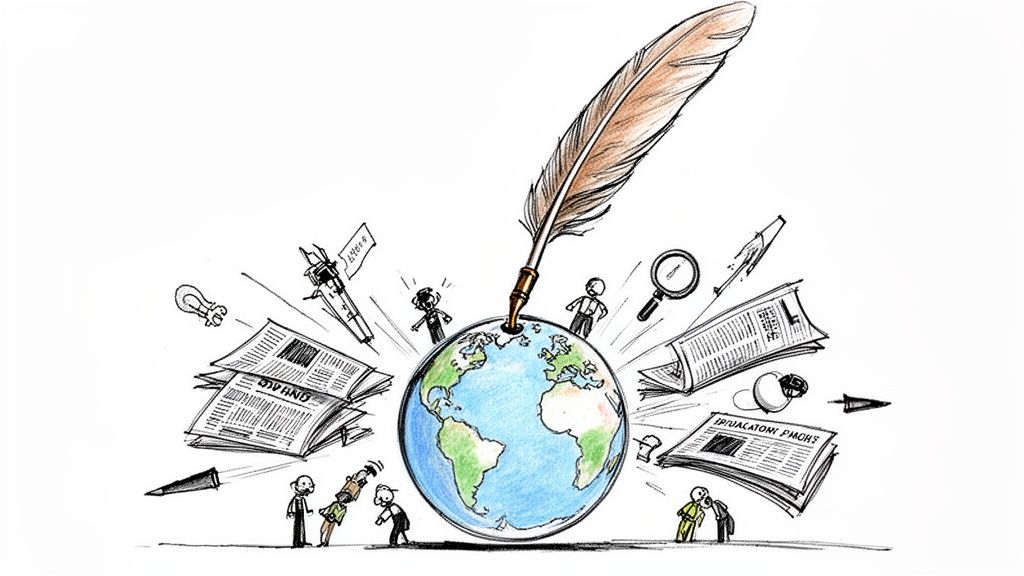
These aren't just funny drawings; political cartoons are a vital piece of how we talk about the world. They have this incredible ability to boil down dense, confusing political messes into a single image you can get in seconds. That's why they work so well—they cut through cultural and literacy barriers in a way a thousand-word article never could.
Think of it as visual shorthand. A cartoonist uses symbols, exaggeration, and a healthy dose of wit to hold a mirror up to society, poke fun at the powerful, and get people thinking. The real goal isn't just a quick laugh; it's to provoke, to question, and maybe even to change a few minds.
A Legacy of Influence
And this isn't just talk—the impact is written all over history. Cartoons have been so persuasive that leaders have both celebrated and feared them. President Abraham Lincoln once called cartoonist Thomas Nast his "best recruiting sergeant," giving him credit for rallying support during the Civil War. On the flip side, powerful figures from 'Boss' Tweed to President Nixon saw cartoonists as genuine threats, which just goes to show how effective this art form is at holding power accountable. You can discover more about the historical impact of political cartoons to really appreciate their influence over the years.
A great political cartoon isn’t just a drawing; it’s an argument. It simplifies the complex, ridicules the absurd, and champions a point of view with unapologetic clarity.
Why Your Voice Matters Today
With all the noise online today, the sharp clarity of a political cartoon is more important than ever. It cuts right through the clutter and lands a memorable punch.
The best part? You don't need a newspaper syndicate deal or a fancy art degree anymore. Thanks to modern tools, anyone with a strong opinion and a bit of creativity can jump into the conversation. This guide is here to walk you through it all, helping you find your voice and make a statement, one panel at a time.
Finding Your Angle and Sharpening Your Message
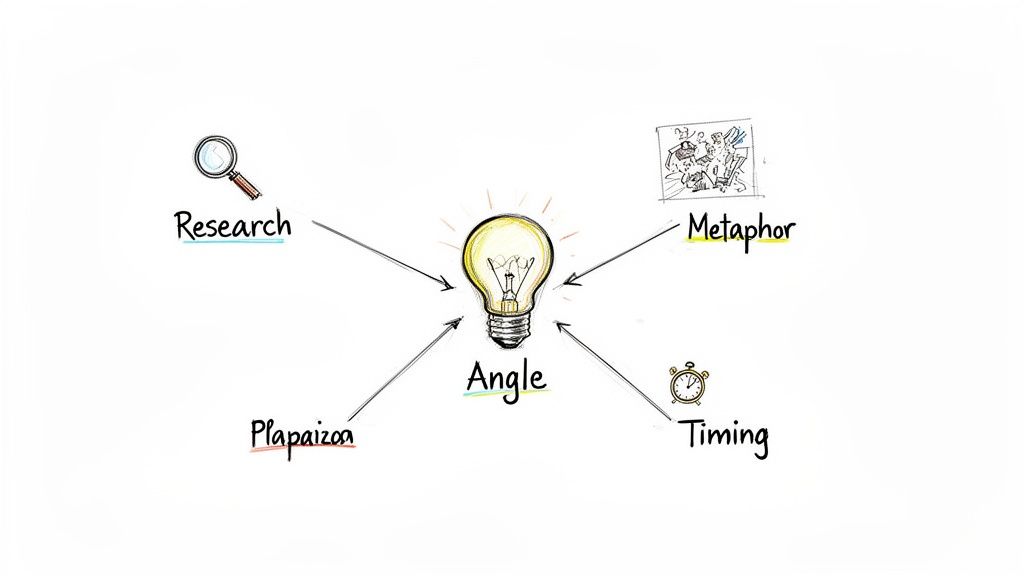
Here’s a secret every veteran cartoonist knows: a brilliant cartoon is born from a razor-sharp idea, not just a skillful drawing. Before you even touch a pencil to paper, the real work happens in your head. You have to find your unique angle and boil down a messy, complex issue into a single, powerful visual.
It all starts with picking a fight. Or at least, picking an issue that genuinely fires you up. A cartoon fueled by real passion or frustration will always hit harder than one that’s just chasing the latest trend. What headlines can't you stop thinking about? What societal quirk just feels wrong? That's your starting point.
This isn’t about just picking a side, though. It’s about finding a specific, often overlooked, piece of the puzzle. Generic anger is forgettable. A targeted, clever insight is what gets shared.
From Broad Topic to Sharp Concept
Once you have a general topic in mind—say, "election integrity" or "economic inequality"—the real challenge is to zoom in. A broad topic is a conversation; a sharp angle is a statement. This is where you put on your commentator hat.
Don't try to tackle the whole beast at once. Instead, find a single absurdity, hypocrisy, or consequence and put a spotlight on it. I always start by asking myself a few key questions:
- What's the real conflict here? I try to find the core tension that makes the issue interesting.
- Who are the main characters? Pinpointing the individuals, groups, or institutions involved is crucial.
- What’s the unspoken truth? I love digging for the hidden motive or the ridiculous reality nobody is talking about.
- What’s the human cost? How does this big, abstract issue actually affect regular people?
This process turns a vague feeling into a solid concept. For instance, instead of a generic cartoon about "inflation," you could draw a family at the grocery store where their shopping cart has a gas pump meter on it. See? That's an angle.
The Power of the Visual Metaphor
The soul of any great political cartoon is its central metaphor. This is the visual magic trick that lets you explain a complicated idea in a blink, often without needing a single word. It’s the bridge between your opinion and your audience's "aha!" moment.
A great metaphor smashes two unrelated things together to create a brand-new meaning. Think of a politician drawn as a puppet with corporate logos pulling the strings. We instantly get the critique of money in politics. Your job is to find a fresh visual comparison that hasn’t been done to death.
Pro Tip: Keep a running list of symbols and metaphors on your phone or in a notebook. When you're stuck, just scroll through it. Sometimes, a random image of a Trojan horse, a sinking ship, or a chess game can spark the perfect idea for whatever topic you're wrestling with.
This laser focus on a single, compelling message is why political cartoons have been so potent throughout history. They became a huge selling point for newspapers back in the late 19th century because one provocative image could speak volumes to a mass audience instantly. You can check out the historical growth of political cartoons to see just how foundational this principle has always been.
Structuring Your Cartoon Idea
To make sure your idea is rock-solid before you start drawing, it really helps to break it down. This isn't about stifling creativity; it’s about building a strong foundation so the final image is clear, focused, and lands its punch. A messy concept always leads to a confusing drawing.
I use a simple framework to organize my thoughts. Before I even consider how to create a political cartoon in Tooncraft, I get these elements down on paper.
Conceptual Framework for Your Political Cartoon
This table will help you break down your idea from a broad topic into a clear, actionable visual concept for your cartoon.
| Element | Guiding Question | Example |
|---|---|---|
| Topic | What is the broad subject? | The rising cost of living |
| Angle | What is my specific point? | Everyday expenses now feel like luxury purchases. |
| Metaphor | What visual comparison will I use? | A regular grocery item is displayed like a priceless diamond in a jewelry store. |
| Target | Who or what am I critiquing? | Economic policies that devalue money. |
| Emotion | What feeling do I want to evoke? | Frustration, dark humor, and relatable stress. |
Once you’ve filled this out, you’ve basically created a blueprint for your cartoon. Your mission is now crystal clear: draw a shopper staring in despair at a single loaf of bread sitting under a spotlight in a glass case, complete with a velvet rope and a ridiculous price tag. The message is sharp, the visual is clear, and the emotion is baked right in.
Bringing Your Big Idea to Life Visually
Alright, you've nailed down your core idea and have a sharp angle. Now for the fun part: turning that concept into an actual drawing. This is where you bring your message to life using the holy trinity of political cartooning: powerful symbols, pointed caricatures, and smart composition. These aren't just artistic choices; they're the very language you'll use to land your punch.
A well-chosen symbol can do a ton of heavy lifting, communicating a complex idea in the blink of an eye. We all know a donkey and an elephant represent the major U.S. political parties. A dove means peace, a hawk means war. Your job is to tap into this shared visual library so your audience immediately gets the context.
But don't stop with the classics. The real genius is in crafting a fresh visual metaphor that makes people pause and think. Instead of the cliché image of a politician in a corporation's pocket, why not draw them as a tiny gardener meticulously watering a monstrous, oversized plant with the company's logo on its pot? It’s more creative, more memorable, and tells a much richer story.
The Art of Purposeful Exaggeration: Caricature
Caricature is probably the first thing people think of with political cartoons, but it's so much more than just making someone look silly or giving them big ears. Done right, caricature is visual commentary.
When you create a political cartoon, you're strategically distorting a person's features to say something specific about their personality, their policies, or their public persona. A chin might be weakened to suggest a lack of conviction. A prominent mouth might be drawn as a literal megaphone to comment on their bluster.
To get good at this, you have to become a student of faces and body language.
- Really Study Your Subject: Don't just glance at a photo. Pull up several images from different angles. What’s the first thing you notice? Is it their eyes? Their posture? That one cowlick that never stays down?
- Find Their "Essence": Try to boil down their whole vibe into a simple shape or feeling. Is their face more square or circular? Do they seem to carry themselves with an air of arrogance or insecurity? This is the core you'll build from.
- Exaggerate with Intent: Once you've got that key trait, push it—then push it some more. But always ask yourself why. Your exaggeration needs to serve the cartoon's main point.
If you want to see how different artistic interpretations can work, it's worth exploring a collection of cartoon styles. Seeing how others turn real photos into stylized art can spark some great ideas for your own approach.
The point of a good caricature isn't just to mock; it's to reveal. You're using visual distortion to get at a deeper truth about your subject. It's about insight, not just insult.
Arranging Your Scene for Maximum Impact
Think of composition as the silent director of your cartoon. It's how you place every element—the people, the symbols, the text—to guide the viewer’s eye and make sure your message hits home, hard and fast. A cluttered, confusing drawing can ruin even the most brilliant idea.
You need to think like a billboard designer. Someone should be able to get the gist in three seconds or less. This means using visual hierarchy. Whatever is most important—the main action, the punchline—should be the biggest, most centrally located, or most eye-catching thing in the frame.
Here are a few simple rules I always try to follow:
- Lead the Viewer's Eye: Arrange things to create a natural flow, usually from left to right, that leads the viewer right to your key visual or punchline.
- Embrace Negative Space: Don't be afraid of blank areas! White space gives your key elements room to breathe and keeps the cartoon from feeling chaotic.
- Keep it Balanced: Make sure the drawing feels stable. A huge figure on one side can be balanced by a couple of smaller elements on the other.
This powerful mix of symbols, caricature, and composition has a long, rich history. The art form really came into its own back in 18th-century England with pioneers like James Gillray, who used his biting wit to take on the ruling class. His work, and early American cartoons like Benjamin Franklin’s famous "Join, or Die," showed the world that a simple drawing could pack a massive political punch. By learning these visual tools, you're joining a long tradition of speaking truth to power, one unforgettable drawing at a time.
Bringing Your Vision to Life with AI Tools
So you’ve got a killer idea, a sharp angle, and the perfect visual metaphor brewing. The only thing standing in your way? Maybe you can’t draw a straight line, let alone a convincing caricature of a public figure. In the past, this is where so many brilliant concepts would fizzle out.
But today, a lack of traditional artistic skill isn't a dead end. Welcome to the modern workflow. With the right AI tools, anyone can transform a well-thought-out concept into a polished, impactful cartoon. This isn't about replacing creativity; it's about giving your creativity a powerful new way to express itself.
Choosing Your Artistic Style
The first real step in using an AI generator like Tooncraft is deciding on the visual tone. The style you pick dramatically affects how your message lands with your audience. A gritty, black-and-white comic book style might convey seriousness and urgency, while a bright, bubbly cartoon style could be perfect for highlighting absurdity through irony.
Think about these common approaches:
- Classic Comic Book: Bold lines, dynamic shadows, and a slightly dramatic feel. This style is great for giving your cartoon a sense of action and importance.
- Minimalist & Modern: Clean lines and flat colors make your message incredibly clear. This approach strips away distractions, focusing the viewer’s attention right where you want it.
- Vintage Newspaper: A slightly faded, newsprint look can add a layer of classic satirical authority, tapping into the long history of the art form.
- Hyper-Stylized Caricature: Some AI styles excel at extreme exaggeration, which is perfect when your goal is to lampoon a subject with over-the-top features.
Your choice should always serve your message. A cartoon critiquing a somber topic might completely lose its impact if it’s rendered in a style that feels too playful.
The core principle here is alignment. The visual tone must match the emotional weight of your argument. A mismatch can create confusion, but a perfect pairing amplifies your message tenfold.
Guiding the AI to Create Your Scene
Working with an AI isn't about hitting a button and hoping for the best. Think of it as a collaboration where you guide the tool with specific instructions. It all starts with a detailed text prompt that acts as your creative brief for the AI.
A weak prompt like "politician talking" will get you a generic, useless image. A strong prompt, on the other hand, provides context, action, and stylistic direction.
Let’s look at how to refine that idea:
- Weak Prompt: A politician at a podium.
- Strong Prompt: Political cartoon of a smug politician at a podium made of cracked, crumbling dollar bills. He is sweating under a single harsh spotlight. Stark black and white ink wash style, heavy shadows, intense expression.
See the difference? The second prompt provides a clear narrative, specifies the key symbols (crumbling money), sets the mood (harsh spotlight), and dictates the artistic style. You’re giving the AI the specific ingredients it needs to cook up an image that actually matches your vision. You're the director, not just a passive observer.
This flowchart breaks down the key elements you can bake into your prompts.
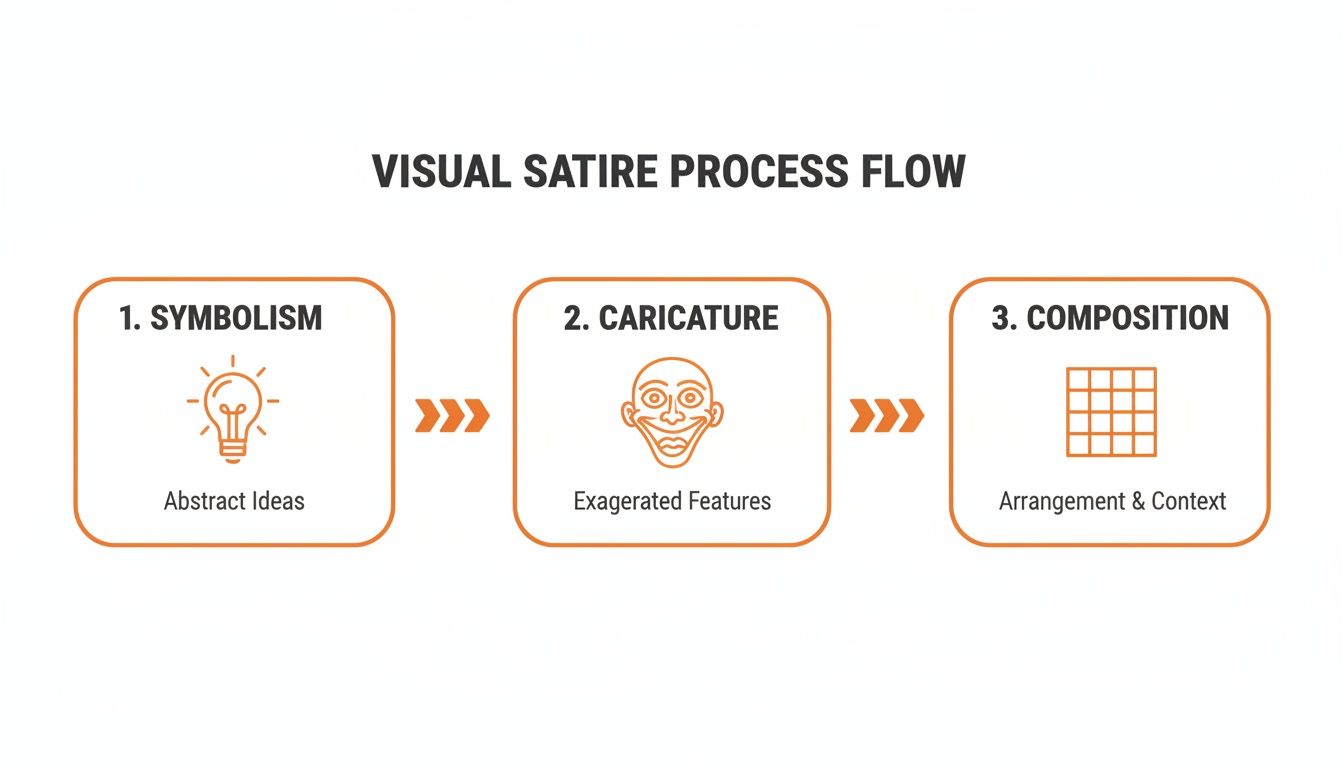
By clearly defining your symbolism, caricature style, and composition, you're handing the AI a solid blueprint to work from.
Final Touches and Human Intervention
Once the AI generates your base image, your job isn't quite done. The final 20% of the work is where you add the essential human touches that make the cartoon truly sing. This is where you can jump into simple image editing software—even free tools like Canva or Photopea are perfect for this—to add the finishing elements.
This is your chance to add crucial context:
- Speech Bubbles: This is where you insert your witty dialogue or that killer punchline. Keep it concise and powerful.
- Captions: A caption can provide the setup for the visual gag or offer a final, biting observation.
- Labels: Strategically labeling key objects or figures can clarify your symbols and make sure your message is impossible to miss.
These text elements are your voice, layered right on top of the AI's artwork. This hybrid approach combines the speed and skill of artificial intelligence with the irreplaceable nuance and wit of a human commentator.
And if you want to take things a step further, the same principles apply to motion graphics. You can learn more about creating AI videos to see how these concepts translate to animation. This modern workflow makes creating a political cartoon a reality for anyone with a strong opinion and a clear message.
Making Your Punchlines and Captions Land
A killer drawing can die on the page if you saddle it with clunky, long-winded text. When it comes to political cartoons, your words—whether they're in a caption, a speech bubble, or a simple label—are just as vital as your art. You’re looking for a one-two punch where the text and visuals work together to make your point stick.
The golden rule here is less is more. Seriously. Your artwork should be doing the heavy lifting. If you find yourself writing a whole paragraph to explain the joke, it's a sure sign the drawing isn't pulling its weight. The text is there to add that final twist, that sharp little jab, or the piece of context that makes the whole thing click.
Complement, Don't Just Explain
Think of your text and art like a comedy duo. One person sets up the gag, and the other delivers the punchline. Sometimes the visual is the setup and the caption is the punchline; other times, you can flip that script.
Let's imagine a cartoon: a politician is frantically slapping tiny band-aids on a colossal, cracking dam. The visual on its own is pretty clear—it's a story about a tiny, useless solution for a massive problem. Now, let’s play with the caption.
- A bad caption (it explains): "The politician uses small, temporary fixes for a huge infrastructure crisis." Yawn.
- A good caption (it complements): "Well, I've addressed the surface-level issues."
See the difference? The second one is funnier and smarter because it trusts the audience to get the visual. It adds a delicious layer of irony that takes the whole gag up a notch. It’s a punchline, not a user manual.
A great caption never tells the audience what they can already see. It adds context, irony, or a final, biting thought that completes the argument and makes the image stick.
Finding Your Comedic Voice
Humor is satire's sharpest tool, but "funny" isn't a single note. The kind of humor you use needs to match the message you're sending. Think of it like having a few different tools in your comedy toolbox.
- Sarcasm: This is the fine art of saying the opposite of what you actually mean. Picture a character doing something incredibly selfish while saying, "It's all about public service."
- Irony: Great for highlighting the gap between what we expect and what's real. A classic example is drawing a "Grand Opening" banner on a business that's clearly boarded up and abandoned.
- Puns: A clever play on words can be a great way to go, especially for topics that aren't quite so grim. A cartoon about political gridlock could show politicians stuck in a literal traffic jam, with one grumbling, "We're not making any progress."
- Understatement: Describing something catastrophic in a ridiculously casual way can create a wonderfully dark comedic effect.
Play around with these. See what feels right for your own style. The aim is to craft a punchline that lands with absolute precision, sharpening your point instead of just hanging around it.
The Strategic Art of the Label
Finally, a quick word on labels. In this game, labels are a kind of visual shorthand. They help the audience instantly identify people, symbols, or ideas. A briefcase labeled "Special Interests" or a smokestack belching clouds labeled "Broken Promises" leaves absolutely no doubt about what you're saying.
But tread carefully here. Over-labeling is one of the most common rookie mistakes I see. You don't need to label every single thing in the frame. Only label the elements that are absolutely crucial for getting the cartoon's main point across. If a symbol is already common knowledge (like a donkey for the Democratic party), labeling it is just redundant noise that clutters your work.
Use labels like a surgeon uses a scalpel: with precision, and only when you absolutely have to.
Getting Your Cartoon Seen and Heard
You've done the hard part. You’ve wrestled with an idea, sketched it out, and created a political cartoon that’s sharp, witty, and ready to make people think. That’s a huge accomplishment, but it's really only half the battle. A brilliant message doesn't mean much if it never finds an audience.
Now it's time to switch gears from creator to publisher. Let’s talk about how to get your work out into the world where it can actually spark conversations, challenge perspectives, and maybe even make a little bit of a difference. This isn't just about hitting "post"—it's about being strategic.
A Quick Word on the Ethics of Satire
Before you send your cartoon out into the wild, it's worth taking a moment to think about the ethics of it all. Satire is an incredibly powerful tool, and with that power comes a genuine responsibility. The most effective political cartoons have always spoken truth to power. They punch up, targeting institutions, politicians, and systems that hold authority over people's lives.
The real goal is to critique and hold the powerful accountable, not to mock or belittle those who are already vulnerable. Before you publish, always ask yourself: who is the real target of my joke? Does this piece challenge an injustice, or could it accidentally reinforce a harmful stereotype? This simple self-check is what keeps your work sharp and meaningful, preventing you from causing unintentional harm.
A good political cartoon serves a prophetic function. It speaks truth to power in order to protect people, fight for their rights, and call authorities to do their job and serve the public.
Mastering the Social Media Game
For any cartoonist today, social media is your megaphone. But you can't just blast your work out there and hope for the best. Each platform has its own vibe and its own audience, so a one-size-fits-all approach is doomed to fail.
-
X (formerly Twitter): Let's be honest, this is the natural habitat for political commentary. The platform is fast, news-driven, and cartoons that tap into the daily conversation can spread like wildfire. Get comfortable using relevant, trending hashtags to pop up in more feeds. And don't be shy about tagging news outlets or public figures (politely, of course!) to pull them into the discussion.
-
Instagram: It’s all about the visuals here, which makes it a perfect gallery for your artwork. Always post high-resolution images. I’ve found that using the carousel feature is a great way to show off close-up details or even walk people through a mini "making of" process. Instagram Stories are also fantastic for sharing behind-the-scenes sketches or getting instant feedback from your followers with a quick poll.
-
Reddit: This place is all about finding your tribe. Subreddits like r/politicalcartoons or r/art are obvious starting points, but don't overlook more specific political or even hobbyist communities where your work might resonate. The golden rule of Reddit: always read the community rules before you post. Seriously.
No matter where you're posting, remember that engagement is a two-way street. When people comment, respond to them. Ask questions in your captions. Jump into broader conversations. Building a community around your work is just as important as the act of creating it.
Building Your Portfolio and Making Contact
While social media is great for immediate impact, a professional portfolio is what signals you’re serious about your craft. This doesn't have to be complicated. A simple, clean website or a dedicated profile on a platform like Behance creates a central hub where you can showcase your best pieces.
Curate your portfolio to highlight your unique style and range. This becomes your calling card when you start reaching out to actual publications. Plenty of online news sites, blogs, and digital magazines are hungry for fresh editorial cartoons.
Here’s a practical way to approach them:
- Do Your Homework: Start by identifying outlets that feel like a good fit for your style and political leanings. Don't just swing for the fences with the biggest names—local news sites or niche political blogs are often far more receptive to new talent.
- Find the Right Person: Scour their website for an "opinions editor" or an "editorial submissions" email. A little digging to find the right name shows you've done your research and aren't just spamming.
- Keep Your Pitch Short and Sweet: Nobody has time for a long-winded email. Write a brief, professional note introducing yourself, link directly to your portfolio, and attach 2-3 of your absolute strongest, most relevant cartoons.
Getting published requires patience and a thick skin. Rejection is just part of the process, so don't let it get you down. Every "no" is just another step on the path to finding the perfect home for your voice. When you combine a lively social media presence with targeted, professional outreach, you create a powerful one-two punch that ensures your cartoons aren’t just seen, but truly heard.
And if you're thinking about taking your commentary to the next level, you might find some great ideas on adapting your work into motion graphics in our guides on creating engaging AI-powered videos. It can open up a whole new world for your cartoons.
Got Questions About Making Political Cartoons? We've Got Answers
Stepping into the world of political cartooning can feel like jumping into the deep end. It’s a mix of art, opinion, and comedy, so it's totally normal to have a few questions buzzing around your head before you get started. Let's tackle some of the most common ones I hear from people just starting out.
"Do I Have to Be a Great Artist?"
This is probably the #1 question, and the short answer is a resounding no. While being a skilled illustrator doesn't hurt, a political cartoon lives or dies by its idea. A brilliant concept with simple stick figures will hit harder than a photorealistic drawing that says nothing.
Think of it this way: your goal is to land a punchline, not to hang your work in a museum. Besides, modern tools can do a lot of the heavy lifting for you, letting your wit and commentary take center stage.
"How Do I Find My Own Style?"
Don't sweat this one too much. Your style isn't something you find; it's something that finds you through practice. It’s the natural result of drawing a lot.
Just start making cartoons. Seriously. The more you create, the more you'll notice your own quirks and preferences. Maybe you'll lean into sharp, angular lines or a more rounded, comical feel. Your unique voice—whether it's dripping with sarcasm, absurdly silly, or just plain angry—will emerge from the simple act of doing the work.
Navigating the Legal and Ethical Minefield
Okay, this is where things can feel a little scary. The "Can I get sued for this?" question is a big one. The good news is that in places with strong free speech protections, satire and parody are well-defended, especially when you're talking about public figures. But there are still a few guardrails to keep in mind.
- Don't Defame: This is about publishing false facts that trash someone's reputation. Your cartoon is an opinion, an exaggeration, a metaphor—not a news report. Keep it that way.
- Respect Copyright: This one's simple. You can't just grab Mickey Mouse or a photo you don't own and stick it in your cartoon. Create your own original work.
- Avoid Hate Speech: There’s a huge difference between punching up at people in power and kicking down at marginalized groups. Good satire critiques systems and authority; it doesn't incite hatred.
When in doubt, remember this: your job is to comment, not to lie. As long as you’re using visuals to critique policies and actions, you’re generally standing on solid ground.
"So... Where Do I Actually Begin?"
This is the easiest one to overthink. Just start. Pick one thing in the news today that gets a reaction out of you—frustration, laughter, disbelief.
Now, try to boil that entire complex issue down to a single, simple visual. Don't aim for a masterpiece. Your first goal isn't to be brilliant; it's just to get an idea out of your head and onto the page. The rest will follow.
Ready to turn your sharpest ideas into shareable art? Tooncraft makes it easy to create a political cartoon, even if you can't draw. Upload a photo, choose a style, and let our AI bring your vision to life in seconds. Start creating today at https://tooncraft.ai.